Air Quality – Monitoring Programs:
Mid West Ports Authority (MWPA) is committed to monitoring and managing dust emissions to minimise the impact of port activities on the community and surrounding natural environment. MWPA undertakes comprehensive air quality monitoring to assess both fine and coarse particulate matter generated through port activities.
To track and assess air quality, MWPA implements the following monitoring programs:
1. Real Time PM10 Monitoring
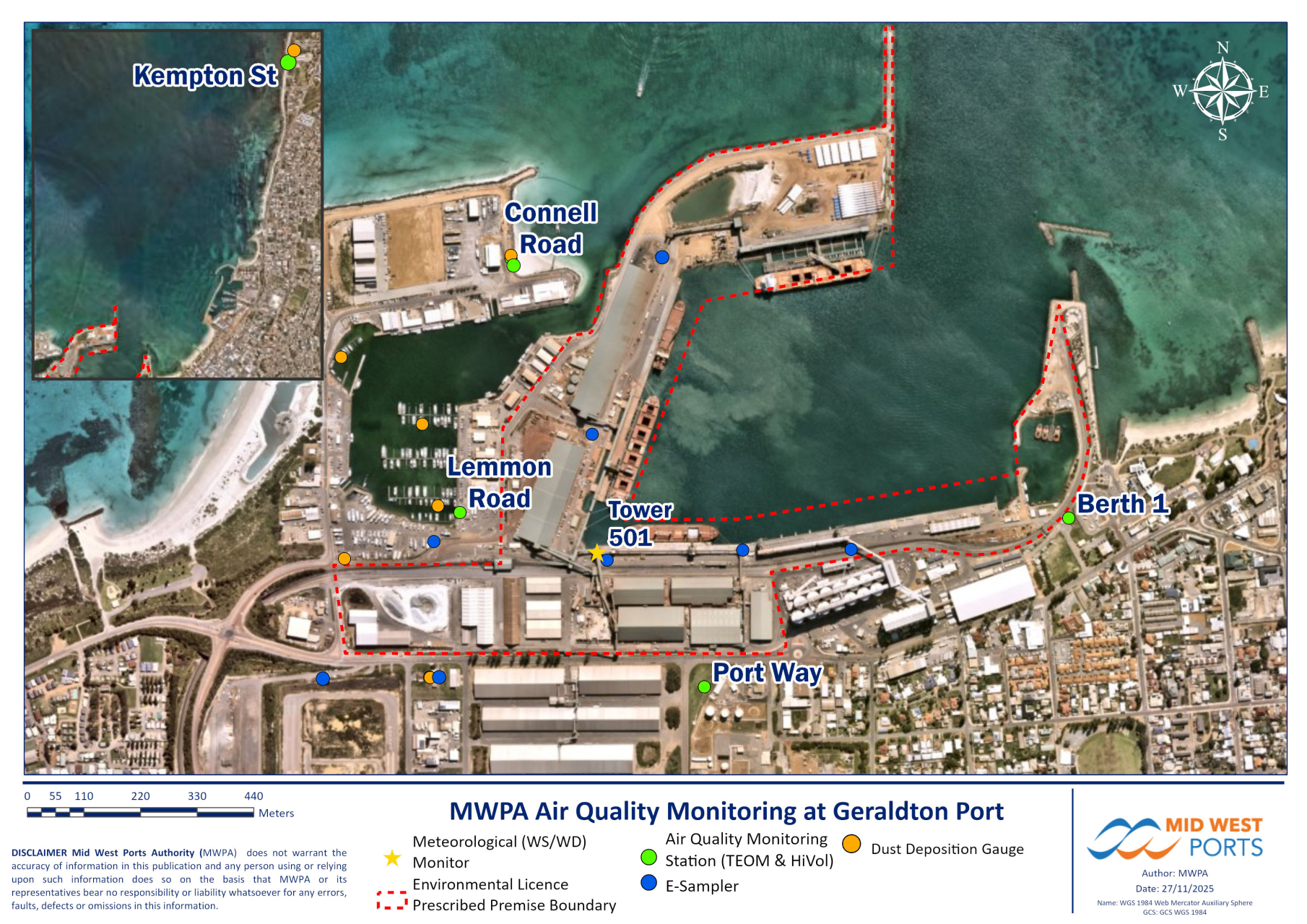
Continuous or “real-time” monitoring of PM10 dust is a compliance requirement under MWPA’s Environmental Licence. Monitoring is conducted via TEOM (Tapered Element Oscillating Microbalance) instruments which measure PM10 levels at 10-minute intervals. Four air quality monitoring stations are located around the Port boundary; named Port Way, Connell Road, Lemmon Road and Berth 1. The air quality levels are compared to background conditions at a Bluff Point (Kempton Street) air quality monitoring station. The 24-hour average concentration from each of these stations are assessed against the regulatory criteria set out in the Environmental Licence.
To supplement this, eight E-Samplers are positioned near key operational areas. These measure PM10 levels at 5-minute intervals to help identify potential dust sources of dust before it travels beyond the Port boundary.
What happens when excessive dust is detected?
MWPA closely monitors real-time dust levels around the port. When elevated dust levels are detected or visible emissions occur during operations, MWPA investigates the source and takes prompt action to reduce emissions. This may include adjusting or pausing activities, increasing dust controls like water sprays, or working with shiploading operators to improve product handling. All incidents are recorded and reviewed to ensure dust management remains effective.
2. High Volume Air Sampling (HiVol)
High Volume Air Sampling is also a licence-based requirement during the loading of metal concentrate products. This monitoring provides a measure of specific metals which are present in bulk products handled at the port, as PM10 particles in air. High Volume Air Samplers (HiVols) are located at all four air quality monitoring stations around the Port boundary. Dust is collected on filters over a 24-hour period and sent to an accredited laboratory for analysis. The results are compared against the regulatory criteria set out in the Environmental Licence.
3. Dust Deposition
Dust deposition monitoring is a voluntary program undertaken by MWPA to assess the longer-term environmental tends in the Fishing Boat Harbour (FBH) precinct. This program provides a measure of dust deposition rates on infrastructure and is used to assess impact to public amenity (nuisance dust) rather than public health.
Six dust deposition gauges are located throughout the FBH, and results are compared against reference sites outside the port to identify any localised increases and seasonal trends.
Dust deposition monitoring locations have been carefully chosen to capture dust from both Port-controlled and non-Port-controlled sources, based on their position relative to operational activities and prevailing wind directions.
The depositional dust gauges collect deposited material over a one-month period and are then analysed to determine levels of organic matter, metals, soluble solids and insoluble solids. MWPA assesses results against the Draft DWER Guideline: Dust Emissions (2021):
- 4 g/m²/month maximum for insoluble solids; and
- 2 g/m²/month above background for insoluble solids
This voluntary program helps identify dust sources, assess potential impacts from port operations, and track the effectiveness of dust controls. Regular data collection also allows MWPA to engage with FBH users and guide improvements where needed.
Community Feedback
MWPA welcomes community feedback and takes all dust related complaints seriously. When a concern is raised, it is recorded and investigated to understand the cause and determine what action is needed. We aim to respond to all complaints within three business days.
All complaints are documented and reported to DWER as part of MWPA’s routine compliance reporting. Community feedback plays an important role in helping us improve how we manage dust, protect public health and amenity.